Friday, May 17, 2013

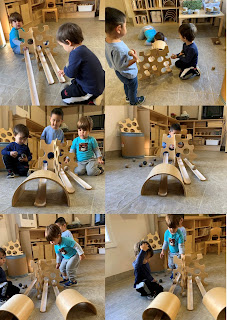
Tree Blocks

The Train
When children begin constructing, do they have intention and if so do teachers direct and divert the children's work with questions such as:

~What are you making?
~ What are you doing?

Or by making comments such as ~This looks like a bus (when it really isn't). This type of labeling limits the children's work.

We find it most helpful to make comments and ask questions that invite discussions.

~You look very busy, tell me what's happening?
~Will you be adding more tree blocks?
~Would you like me to get you some loose materials?

In this episode the girls told us they were making a train.One long enough to hold two passengers.


~I see that you left spaces  in between the blocks. What are they for?

 ~What else will you be adding to your train?

~The space is for the seats and we will add the steering wheels!

 ~Will you be travelling far away today?

And so the discussion continues....


Wednesday, April 24, 2013

Learning Stories

I came across this article written today and thought I would share it with you. It's definitely a consideration for teachers to document in this manner. How does it differ from the Reggio Approach to documentation? Let me know your thoughts. Technology Rich Inquiry Based Research has some very good articles to share.

Documentation and Assessment: the power of a learning story


Learning Stories, as developed in New Zealand by Margaret Carr (2001) and her colleagues are...”a particular form of documented and structured observations that take a storied approach and a non-deficit (credit) approach, and an underlying agenda of protecting and developing children’s identities as learners in accordance with the national early childhood curriculum...” (Carr, M., Cowie, B., Gerrity, R, Jones, C. & Pohio, L., 2001, p. 29). In New Zealand, this national curriculum is Te Wháriki. (http://www.educate.ece.govt.nz/learning/curriculumAndLearning/TeWhariki.aspx)

The examples of curriculum used in this narrative are from the OELF (Ontario Early Learning Framework, (2007) – (http://www.edu.gov.on.ca/childcare/oelf/) with reference to The Capacity Building Series: Pedagogical Documentation, K-2 (2012) as produced by the Literacy and Numeracy Secretariat to support leadership and instructional effectiveness in Ontario schools -(http://www.edu.gov.on.ca/eng/literacynumeracy/inspire/research/CBS_Pedagogical.pdf) and the blog musings of an educator, Dr. Konrad Glogowski, a Vygotskian inspired blogger and teacher who has explored the use of Learning Stories in middle and high school (http://getideas.org/thought-leader/learning-stories-part-one/).
Learning Stories: Conducting Learner Identities in Early Education (2012) is the newest publication on learning stories by Margaret Carr, University of Waikato, New Zealand and Wendy Lee, Director of the Educational Leadership Project, New Zealand (http://www.elp.co.nz/index.php).
learning story book
“Margaret Carr's seminal work on Learning Stories was first published by SAGE in 2001 and this widely acclaimed approach to assessment has since gained a huge international following. In this new book, the authors (Margaret Carr and Wendy Lee) outline the philosophy behind Learning Stories and call on the latest findings from the research projects they have led with teachers on learning dispositions and learning power to argue that Learning Stories can construct learner identities in early childhood settings and schools. By making the connection between sociocultural approaches to pedagogy and assessment and narrative inquiry, this book contextualizes learning stories as a philosophical approach to education, learning and pedagogy.” (http://www.fishpond.co.nz/Books/Learning-Stories-Wendy-Lee-Margaret-Carr/9780857020932)
The Educational Leadership Project, directed by Wendy Lee, hosts a wealth of information and examples of Learning Stories at: (http://www.elp.co.nz/EducationalLeadershipProject_LearningStories.php). Please note that the videos cannot be played but will hopefully be made available for public use soon.So what is a Learning Story?
409597_491431134204329_655923523_n
Jenna and Mark, I noticed how thoughtfully you negotiated a fair plan to gather the beans from the garden together. You helped one another with the task and showed a great deal of co-operation and understanding of each others ideas for completing the task.
The vignette above serves as a very brief visual and textual example of a Learning Story and is only a section of a larger documentation piece but it serves to give the reader a sense of the tone and flow of a Learning Story. Learning Stories offer a thoughtful and reflective window into a child or children’s learning as this learning happens and these stories attempt to describe unique experiences or moments that cause teachers to pause, wonder or consider a particular event. At their best, Learning Stories inform future curriculum paths and directions, serve as assessment in children’s portfolios, develop into invitational and engaging democratic documentation, are gathered into classroom journals and can be quickly reformatted to email to families as a newsletter. In middle and high school environments, learning stories have been utilized for student assessment and evaluation. Dr. Konrad Glogowski, a Vygotskian inspired blogger and teacher provides a beautiful description of learning stories on his blog and as a featured Thought Leader at GETideas.org:
“Learning Stories are about documenting, through narratives, what children can do and what they are learning. They represent learning as essentially a dynamic, evolving, and ongoing process. They do not reduce learning to a score that children get at the end of the unit or semester … or a level that defines them as they start a new school year, with a new teacher. As opposed to our well-established modernist approaches to assessment, Learning Stories do not highlight deficiencies, weaknesses, or mistakes. They recognize that each child is a unique individual who interacts with the world around her and learns differently, through a process that is uniquely her own. Learning Stories view learning as a holistic endeavour, not a collection of subjects or skills that the child must master, and they therefore focus on learning as exploration and a process of inquiry. Teachers who use this approach are also well aware of the fact that learning takes place all the time, not just in the classroom, and they involve parents and other family members in documenting the child’s development and commenting on narratives written by the teacher.” (http://getideas.org/thought-leader/learning-stories-part-one/)
Although Dr. Glogowski works in a learning community of students far beyond the early years, when challenged to articulate his approach to classroom assessment and practice in keeping with 21st century learning, he found synchronicity in the early childhood education curriculum and policy document, titled Te Whariki, developed by the government of New Zealand. He notes that national curriculum is founded on the following aspirations for children,
“… to grow up as competent and confident learners and communicators, healthy in mind, body and spirit, secure in their sense of belonging and in the knowledge that they make a valued contribution to society.”
Reading these words, one can’t help but be reminded of the Reggio inspired image of the child as being, “capable, competent and confident.” Similarly the sociocultural narrative of a Learning Story is pleasingly aligned with a Reggio inspired view of children as protagonists of their own learning, each with their own personal, historical and cultural identity.
So what makes a good learning story?
1. A protagonist! How convenient! We get to start with a Reggio inspired perspective of learning. Below is a learning story vignette featuring a protagonist, Jane.
392421_457369954277114_1574759425_n - Copy
Jane, I noticed this morning that you spent a long time measuring the garden vegetables with a piece of wire. You carefully wrote down the number of “spaces” on a sheet of paper based on the marks you had made on the wire. You concentrated very hard on making the marks even so that you got an accurate “measure.” You stated that, “we don’t need so many leeks to make soup as we need onion,” and then set out to solve your hypothesis by determining the length and weight of each vegetable.
Every good story needs a central character and in the case of Learning Stories it is a child or group of children. Learning Stories are never about the teachers view of children’s learning or about a group of children who represent a general example of learning for a specific age group. If your story begins, “we had fun at the zoo”, you have no protagonist.
2. Action. Every good story has some type of adventure or movement. In the case of a Learning Story, consider writing about moments in the day when you as an educator are curious, perplexed, filled with wonder or incredulity. So what about the assessment piece? Rather than looking for a “learning moment” that represents a prescribed area of development, write about one of the things above, then later, try to situate the occurrence in your learning framework. For example, the narrative above is one piece of a larger document highlighting examples of development as described in the continuum of the OELF (the link below takes you to this document).
Remember, development and learning are always happening, concentrate on capturing what you see, knowing intuitively its significance and later worry about situating the event in whatever curriculum or assessment tool you must adhere to as teachers. The Learning Story vignette about Jane and measurement of the leek shared above highlighted many examples from the OELF developmental continuum, specifically within the developmental domain of cognition; some of these are highlighted below:

4. Cognition
4.2 Problem Solving
4.3 Representation
4.4 Questioning
4.5 Observing
4.6 Collecting and Organizing Information
4.7 Reflecting and Reaching Conclusions
4.8 Communicating Findings
4.15 Representing Numbers
4.19 Measuring Length, Weight
3. An antagonist. No, not necessarily in a negative way. The antagonist might be another child, the teacher, sometimes, as in the case of the Learning Story vignette shared below, it is the mastery of a paint brush.
385749_468291506518292_157846827_n
Maria, I noticed how long you spent at the art table outdoors realistically representing the grapes in our garden. Your careful work with the paint brush resulted in three very unique grapes, hanging from the vine. Your artwork was appreciated by others as they stood beside you to watch.
4. Conflict. Not conflict as you may imagine, such as an argument but something that results in a challenge. A good example is an interpersonal moment between two children, such as the one shared in the first Learning Story vignette or in the case of the Learning Story vignette below. The conflict these two children obviously face is the challenges they must overcome when indoors for long periods of time.
547874_468295206517922_1676684141_n
Sam and Teddy, I have noticed how much pride you have taken in your work in the garden. Sometimes when we are inside you find it hard to wait to get outdoors. Once in the garden, I noticed how persistent you were about getting rid of the weeds together.
5. And finally, resolution. The very first Learning Story shared in this narrative was about Jenna and Mark and how they used their negotiation skills to find a way to fairly harvest the beans. Jane found resolution by selecting a tool of measurement that proved successful in her attempt to estimate vegetables needed for soup. Maria, in her mastery of the paint and brush found resolution in her representation of the growing garden grapes. The resolution for Sam and Teddy was a new found sense of self and pride in conquering the weeds.
So aren’t we supposed to be objective?
Pride! Sense of self! Do these observations belong in an assessment tool? Yes! Learning Stories are written in the first person, they are filled with teacher subjectivity, honesty, joy, excitement and interest. How refreshing when compared to the observational techniques we endured in our early training. Our training in child development was scientific and focused on our ability to compare a child to a certain stage based on a set of criteria found through our observations. Learning Stories epitomize a narrative, sociocultural, feminist, indigenous approach to the study, assessment and documentation of children’s learning. Learning Stories challenge the idea that development occurs in predictable, prescribed sequences that are universally applicable. Learning Stories take a credit rather than a deficit approach to learning. Learning Stories are not about what children can’t do, or where or what they are progressing towards, they are about where they are now. Learning Stories celebrate the child. Works for us!
Learning Stories are also appearing with increasing frequency in pedagogical documents disseminated by the Ontario Ministry, The OELF (2007) lists Learning Stories as a preferred method to “create a holistic picture of a child’s learning and experiences.” The early learning framework describes Learning Stories as, “narrations that document children’s engagement in learning experiences, including the analysis or assessment of that learning and the child’s emerging developmental skills. The observation, documentation and analysis of Learning Stories create a sample of children’s learning that is rich in context, articulate and complete in terms of the situation, the actions and the conclusion” (pp. 80-81).
A document, recently released to support pedagogical documentation in Kindergarten to Grade 2, The Capacity Building Series: Pedagogical Documentation, K-2 (2012) - (http://www.edu.gov.on.ca/eng/literacynumeracy/inspire/research/CBS_Pedagogical.pdf ) mentions Learning Stories as format which can be made available in a variety of ways for reflection on a child’s or a class’s learning process (e.g., in a letter/e-mail, newsletter, or blog)(p.7).
The Learning Story that has been shared throughout this post was used in two ways. As an assessment portfolio tool Learning Stories for Portfolios and as documentation of the Garden Project Learning Story Documentation. It is with heartfelt thanks that we honour the Acorn School for providing us with the Garden Project photos! (The stories written around these photos are fictional and the names of the children featured in these stories have been changed).
Some Final Considerations:
Like all good stories, a well written Learning Story is engaging and invites the reader to return to read it again and again. Consider these few pointers as you begin your first (or next) Learning Story:

memorable titles
story structure, including a beginning middle and end
design....pictures are an integral part of telling a story
attention to detail...the importance of editing...having other readers reflect and critique the story
and including families...the best Learning Stories have a passage written by the parents or families of the child

Friday, April 19, 2013

Picasso One of the Most Influential People of the Last Century

Our Sk classes have begun a study of the hundred most influential people of the last century.
One of the teachers sent me this experience today. Picasso is the first person they are studying and although the art work is beautiful it was not the only thing that caught the teacher's attention.
Note how the younger child watches her older peer, carefully studying her technique before she attempts her own Picasso rendition. This was a wonderful way to document how children learn from each other.


Monday, April 15, 2013

They Heard a Sound!

If weather permitted and we could move our classrooms outdoors, imagine the possibilities.
This group of toddlers took a morning walk into our neighborhood "forest" and made and interesting discovery.
"Sounds are Everywhere"
In the bark of the tree trunk.


On the ground as she taps her sticks.

The sound is louder when friends join in.
Up high as they shake the tree trunk and rustle the leaves.


Could they in turn offer their own sounds to the forest?


Saturday, April 13, 2013

Castles & Dragons-a Perfect Pair

Much of children's story telling finds its roots in fantasy. All we have to do its take those stories and bring them to life. These types of experiences can enrich a classroom for months.
This was a child's sketch of a Casa Loma, the dragons and the knights.


Tuesday, April 9, 2013

Teaching is a Leap Of Faith


Teaching is a leap of faith, especially when we work with the youngest of children, who rarely even remember us.
So what is our gain because isn't it a truth that we all like to see results, both long term and short?
Is it enough to for us to know that if we give the children the best of ourselves as teachers and people we will leave a small imprint?
I think that elementary school teachers, and more so private school teachers, who sometimes have the children from kindergarten to grade twelve are so fortunate. Imagine the wonderful journey they share as they watch the children grow not only as students but also as citizens of the world.
So I offer this.
Never let a day go where you don't appreciate your students.
Respect them.
Cherish the memories you create together for even if you are not remembered by the mind, you will be remember by the soul.
Laugh often, give freely, find the child inside yourself.
Be kind.
Never come empty handed instead fill your arms with incredible resources.
Know each child, they are all different and cannot be crowded under the umbrella of just being
"children"
Not every day will be a perfect day most often they will be fraught with the ordinary. Even in the ordinary amazing things happen.
Share your ideas, knowledge, resources, and thoughts, with other teachers. Teaching is not a race to the finish line, nor a competition for recognition. Teachers transform the world. Remember, it is in this sharing that we create the storm of change.
Have an extraordinary day!

Friday, April 5, 2013

Let them Draw!

We know that children move through many stages of drawing from scribbling to representational drawings that demonstrate theories, thoughts, fears, dream, ideas, concepts. In fact children are extremely proficient drawers. 
The question is, can we assist them to move through the various stages? Or do they have to stay in that stage until they are READY?
What exactly does ready mean?
Drawing Number 1
Child draws a representation of herself.
Drawing Number 2

The teacher prompts her to take a closer look at herself in the mirror.
Look in the mirror. What shape are your eyes.
What about your nose and mouth, your hair, what shape are they? Are they close together?
Let's think about your body.
Are your arms  that thin are are they thicker?
The child then considers the discussion and makes changes to her drawing (2).
The next day the teacher wonders if the child will revert to her first form of drawing or will she continue to draw using the newer skill set.

This is the drawing she did the next day. 
Drawing Number 3


Thursday, March 28, 2013

What is Scary?


Scary, to cause fright or alarm, has many interpretations depending on the person who is scared.
For children the source of "Scary" can be come from anywhere; a fire alarm, a imagined monster, a character in a movie or book, a neighborhood dog. The list is endless.
So how do we help them to deal with "scary"
Drawing and discussions are a good place to start.
For Sophia, aged four, scary was the witch in Snow White.

Of particular "scariness" were her long fingernails, the wart on her nose and her scary nose. Sophia chose the color green to accent the features that scared her the most.
She also added a bubbling cauldron filled with poison apples.

Here is her story

A witch isn't real it's just in your mind. If you think about it in your mind it could be scary but it's not real. It's just imagination because there is no such thing as witches because they're just in movies and stories. They're scary because they could kill people and because they scare people and eat people.

These are the witch's black crows. The crows have red beaks and they are nice and furry and soft and they have black feathers. Inside the wings they have red poison. You can't see the poison because it's black but I made it red so Tiziana could see it.  They spray the poison on people who come too close because that means the crows are afraid of the people . The poison is going to kill the people. They're bad crows because they spray poison on people and they want to hurt them just like the queen who gave the poison apple to Snow White.

The pot is bubbly and it's for the apple for Snow White. The apple is poisoned and nice and shiny and red and it's crunchy if you eat it. If you eat it it is going to be poisoned. It has a black dot on it and that is where the poison is.

The witch is angry and mad and she has a mirror  mirror on the wall because it always tells her Snow White is the fairest of them all. She's angry at Snow White and she always kills Snow White and she wants to be the fairest of them all.
The spiders are creepy and crawly and they always tickle you if they crawl on you. They eat flies and they live in cob webs.
The nails are pointy and they're sharp and she can't make a fist because she'll hurt herself and nobody can touch her nails.
Snow White died because she took a bite of the poison apple and the Prince might have to kiss  her.
And that's why I think that the witch is scary!


Monday, March 18, 2013

Nature, Nurture or Both?


Meet Marlow (the youngest of my nieces), a capricious two and half year old that would astound the most seasoned educator. This preschooler has the vocabulary of a child 3 times her age, she recognizes letters and is able to give examples of words that begin with the letter sound. She sat through the Broadway production of the Wizard of Oz and was able to answer questions about the story line, knowing that in order for Dorothy to get home she had to bring the Wizard the witch's broom. She recalls details of family vacations and events. She converses in full sentences, using part of the question in her answer. She holds her pencil using a firm pincer grasp and draws a face; two eyes, a nose, mouth and a tear drop for good measure.

So what makes Marlow so exceptional? Was she born with amazing aptitude or is it environment?
Marlow has two older siblings 12 and 10 years old and she attends daycare. 
She has one cousin who is her age but all the rest are  in their late teens and early adult years.
Spending a few hours with Marlow will leave you thinking.
How much should we offer children? Should we limit our classrooms based on the general guidelines of development or should we offer more? 
I offer that Marlow is both, gifted and nurtured by her environment.
As educators we should provide children with a rich context giving due consideration to developmental milestones but not being limited by them.


Wednesday, March 13, 2013

Light and Drawing the Perfect Pair!

This afternoon, as I browsed through old folders, I came across these beautiful photos. Of course, I've seen them many times, but today I was captivated by the way the sunlight filtered through the window and came to rest on the children and their work. The beauty of this particular experience was not only about the art created but also about the way the drawing table was placed by the window with intention. It makes us reflective of how the environment impacts an experience.

Tuesday, March 5, 2013

A Bucket Full of Gadgets!

When you provide children with a bucket full of objects, interesting experiences happen.